Mini Split Installation in Pocatello, ID
A new system here will heat from September through June and cool from July through August every year. Tell us about the house, and a licensed contractor who covers Bannock County will get in touch.
Tell us about the job
It takes about a minute.
Ten months of heat, two of cooling, in a place that loses power
Bannock County asks a mini-split to work almost all year. Heat runs September through June, and winter nights average 18°F through December, January and February. The unit you install has to hold up on those cold nights for ten months, then switch over and cool through July and August afternoons that average 81°F.
A new mini-split installed today has to meet the federal minimum for split-system heat pumps, 14.3 SEER2 for cooling and 7.5 HSPF2 for heating. Idaho also sees its share of winter storms, and in 2024 eleven percent of households in the state lost power for 24 hours or more. Worth asking whether the unit you choose can run on a smaller backup source if the power goes out on a cold night.
- 10 months
- September through June, your system heats
- 2 months
- July through August, it cools
- 18°F
- the average winter night it heats against
- 81°F
- the average summer afternoon it cools against
NOAA nClimDiv, 1991–2020 normals
Idaho requires HVAC contractors to hold a state license.
The license is issued to the contractor, not to each job, so the same license that lets a company install a furnace or water heater covers the mini-split going into your home. The HVAC Board is who holds that license and stands behind it.
Most cities and counties in Idaho require a permit for this kind of installation, along with an inspection once the work is done. That is where the wiring and the line set connections get an independent check beyond the license itself.
Sources: Idaho Legislature · Idaho Division of Occupational and Professional Licenses
- Is a mini split worth it?
- For most homes here, yes, especially if you're heating with something other than gas or need to cover a room your furnace doesn't reach well. A mini split heats and cools the same space with one system, and it keeps working room by room even if the rest of the house is on a different setup. Down to 18°F on a winter night, a good cold-climate heat pump still puts out heat, though a contractor should confirm the specific unit is rated for that. Idaho sees its share of winter storms and outages, and a mini split on its own circuit can keep at least part of the house heated when the power situation elsewhere in the house is down.
- How many rooms can a mini split cover?
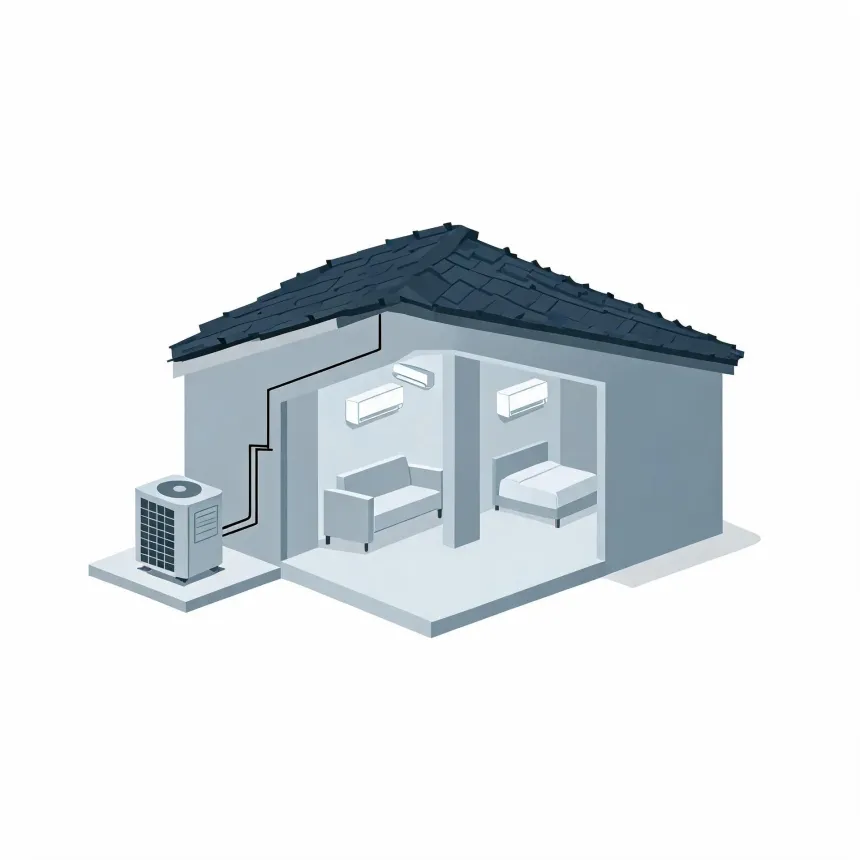
- That depends on how many indoor units you install, not on the outdoor unit alone. A single-zone system heats and cools one room or open area. A multi-zone system runs several indoor heads off one outdoor condenser, so it can cover several rooms at once. A contractor sizes the system to the square footage and layout of the specific house.
- Can a mini split heat a whole house?
- It can, if it's sized and placed for that from the start. Whole-house coverage usually means either a multi-zone system with an indoor unit in each main room, or a ducted mini split that pushes air through a duct system the way a furnace does. With lows around 18°F here for much of the winter, whole-house heating with a mini split means picking a cold-climate model rated to keep up at those temperatures. A contractor can work out whether your house is a good fit and how many zones it needs.