Idaho HVAC Pros
Side profile of a bearded man wearing a faded dark blue baseball cap and a matching dark T-shirt against a plain light gray background.

Signs your ducts need cleaning in Boise City, ID

Duct and vent cleaningDucts or ventsAda County, ID
Step 1 of 2

What ZIP code is the job in?

What are the signs your ducts need cleaning?

Dust on the furniture again a day after you cleaned, or a musty smell when the furnace kicks on. You're not sure if that means the ducts need attention or if it's just the dry Boise air doing what it does every summer. Before you call anyone, it helps to know what actually points to dirty ducts versus what's normal wear on a system working through another Ada County winter or summer.

Dust that returns fast, a musty smell from the vents, and weak airflow in some rooms

If you dust a room and it looks dusty again within a day or two, that dust is circulating through the ducts, not just settling from the air. A musty or stale smell when the furnace or AC first kicks on points to dust or debris sitting in the line. Weak airflow from some vents while others blow fine usually means a blockage somewhere in the run. In Boise, dry summer air carries fine dust and pollen into the system, and winter heating pushes it right back out through the vents. If anyone in the house has started sneezing more at home than elsewhere, that's worth paying attention to as well.

Unfinished basement with exposed wood joists, galvanized sheet-metal ductwork, insulated flex ducts, piping, a small window, and a furnace or air handler against a gray wall.

Ducts doing their job

Clean metal and flex duct carry air from the furnace to every room without adding anything to it. No dust ring at the supply vents, no musty smell when the system kicks on, no extra layer settling on furniture between cleanings.

Empty basement room with bare concrete walls and floor, and an exposed ceiling of wooden joists with large galvanized sheet-metal ductwork and pipes.

Ducts that need a look

Dust built up inside sheet-metal duct runs gets pushed into the house every time the furnace or AC fan turns on. If you can see buildup where ducts are exposed, near the furnace or in an unfinished area, the same is coating the runs you can't see.

Why does duct buildup sneak up on homes here?

  • Half the homes here were built by 1997

    Half the homes in Ada County were built in 1997 or earlier. Older duct runs have had more years to collect dust, and more joints where it can gather.

  • Heat runs October through May

    Furnaces here run about eight months a year, October through May. That's eight months of air moving through the same ducts, carrying whatever is already in them.

  • Cooling runs June through August

    AC runs June through August, so for three months the same ducts push cooled air instead. Dust sitting in the lines gets stirred into both seasons.

ACS 2020-2024 · NOAA nClimDiv 1991-2020

Dust doesn't come from nowhere. It comes from somewhere it can sit and build until the blower moves enough air to stir it loose.

A duct system that's collected years of it just keeps feeding it back into the house, load after load, no matter how often you dust the shelves.

A bearded man in a dark t-shirt sits on a light sofa, smiling and looking down toward a laptop screen visible at the bottom edge of the frame, with a blurred living space behind him.
A bearded man in a plaid flannel shirt looks out a window at snow-covered conifer trees, with a steaming ceramic mug on the sill and wooden shelves holding dishes and a plant behind him.

How a duct cleaning actually works

  • A duct cleaning starts with a camera run through the main trunk to see what's actually built up before any brush touches it.
  • Every supply and return gets sealed off except one, so the vacuum pulls air through the whole system instead of just the nearest vent.
  • A rotary brush or air whip knocks dust loose from the inside of the metal, working section by section toward the vacuum.
  • The furnace blower compartment and coil get cleaned too, since dust sitting there feeds right back into the ducts once the system runs.
  • Flex duct near the furnace often needs more passes than hard metal trunk lines, because its ridges hold dust metal doesn't.
  • The supply registers get pulled and cleaned last, after the dust upstream has already been pulled out, so it doesn't just resettle there.

A duct cleaning isn't someone sticking a hose in a vent for a few minutes. It starts with a camera, so whoever's doing the work can see how much has built up and where, instead of guessing. From there the system gets sealed off one opening at a time, leaving a single point open so the vacuum has to pull air the full length of the ductwork rather than just at whatever vent is closest. That's what gets the far end of a long run, not just the easy parts near the furnace. A rotary brush or an air whip does the actual work of breaking dust loose from the inside of the metal, moving section by section toward the vacuum so nothing just gets pushed further down the line. Flex duct near the furnace usually takes more passes than the hard metal trunk, since its ridges catch dust that metal doesn't hold onto. The blower compartment and the coil get cleaned too. If that gets skipped, the dust sitting there blows straight back into clean ducts the next time the furnace runs, and the whole job undoes itself in a season. The supply registers come off and get cleaned last, after everything upstream is already out, so they're not just catching dust that's still settling from the rest of the system.

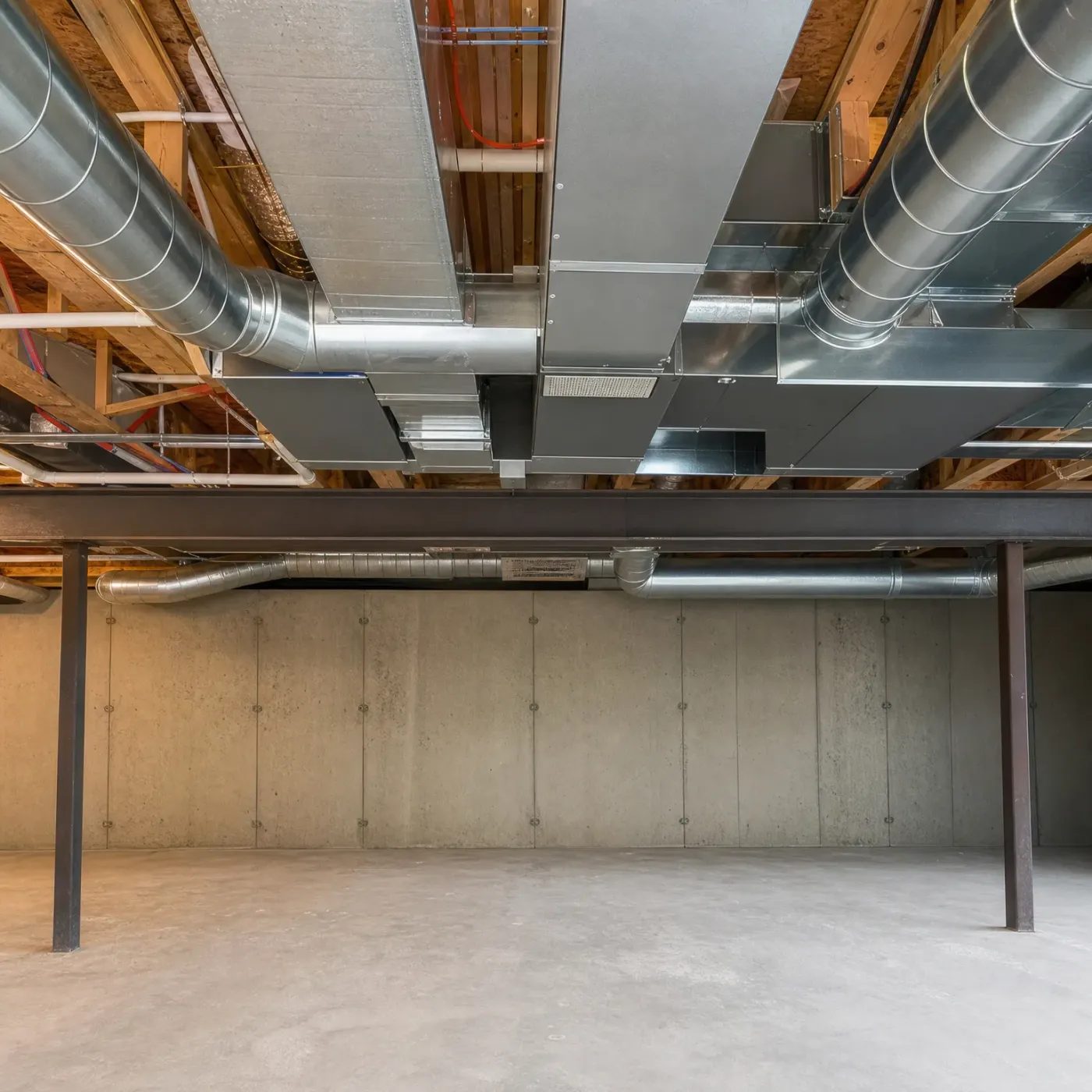
Unfinished basement with concrete walls and floor, a steel beam on posts, and exposed wooden joists with sheet-metal ductwork and piping overhead.
Steel and spiral duct run tight to the joists, no dust ring showing at any seam.
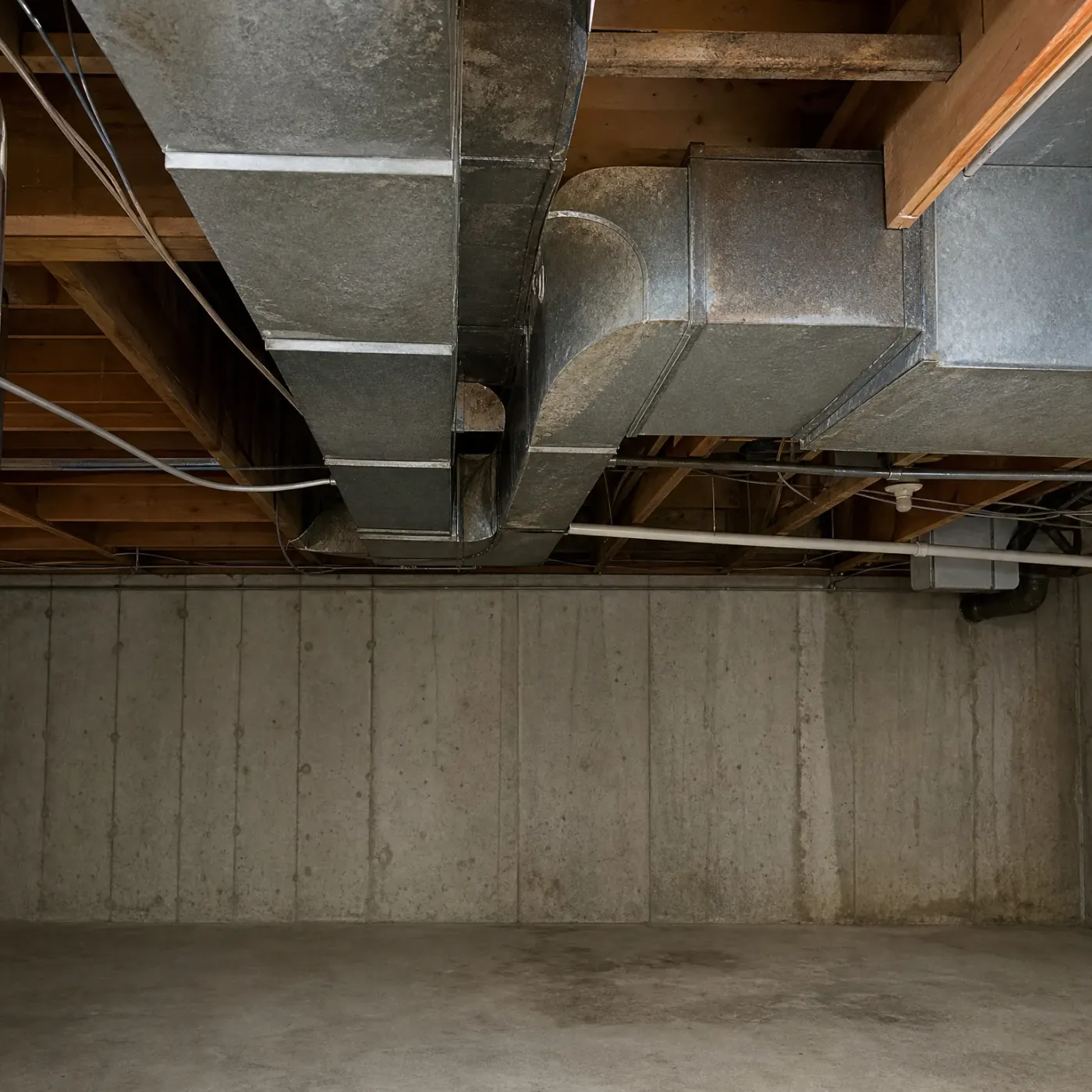
Unfinished basement with bare concrete walls and floor, and galvanized sheet-metal HVAC ducts, pipes and wiring running along the wood-joist ceiling.
Here every joint has started shedding, leaving a gray film across the boxes below.

Clean It Now Or Wait It Out

Clean it now

  • A scheduled cleaning happens on your timeline, before the dust is bad enough to settle back onto furniture within a day.
  • A tech can run the camera through the trunk line while everything is still accessible and note any gaps in the insulation or loose joints.
  • Catching buildup early means fewer passes are needed to clear each run, since the layer hasn't had years to pack down.
  • You get to pick the week, rather than scheduling around a musty smell that's already bothering the whole house.
  • A local tech who works on Ada County duct systems all year knows which builds and vintages tend to collect the most and checks those first.

Wait on it

  • Every month the furnace runs, more dust gets pulled through the same runs and settles in the same spots.
  • A smell that shows up only when the furnace kicks on usually means something sitting inside the ducts, not the dry air outside.
  • The longer buildup sits, the more of it rides the airflow back into the rooms, which is why furniture collects dust again so fast.
  • Waiting through a full winter gives the system eight more months of October-through-April runtime to add to whatever's already built up.
  • Once the smell or dust has become a daily annoyance, there's less choice about scheduling, since the problem is already pressing.
A smiling man in a dark green sweater sits at a wooden table with a light gray mug in a kitchen with white tile backsplash, pendant lights, and an adjoining living room visible.
A smiling man in a dark gray sweater stands indoors looking to the side, with a kitchen counter holding a ceramic mug and open wooden shelves behind him and a living area in the background.
A smiling man in a dark blue button-up shirt stands at a white kitchen island, with open shelving, a gas range, a potted plant and a window in the background.
A smiling man with dark wavy hair and a beard, wearing a dark green knit sweater, sits in an open-plan living room and kitchen with a brown sofa, large windows, and a counter holding a mug and a wooden bowl.

It's off your list after this

Dust that comes back a day after cleaning doesn't settle on its own. It's riding the air the furnace pushes through the ducts, and if the ducts are the source, dusting the furniture again won't fix it. A local contractor who runs cameras through duct systems all over Ada County every winter knows the difference between dust that's just dry Boise air and dust that's been collecting in a trunk line for years. That's the call this makes. One contractor gets your request, the one who already knows what eight months of furnace use does to ducts around here, not a handful of companies competing for the job. You've already noticed the smell or the dust. Sending the request is the part that's easy, and it's the part that gets someone looking at your actual ducts instead of guessing from a search result.

What you'll keep noticing

Dust back on the end tables a day after you wipe them down. A musty smell the first few minutes the furnace runs, then it fades. Registers that need dusting every week instead of every season. None of it is dangerous on its own, but it's the same cycle repeating, and wiping the furniture again doesn't touch what's feeding it. If the smell shows up each time the system cycles on, that's air moving through the same buildup every time, not a one-time thing that'll clear itself out.

What it costs you over time

A furnace pulling air through ducts coated in dust works a little harder to move the same amount of air, month after month, October through May. It's not a dramatic jump on any one bill, but it adds up over a full heating season. Meanwhile every supply vent keeps delivering a share of what's built up inside, back into the rooms you're trying to keep clean. The longer it sits, the more there is to move, and the more often you're back to dusting furniture that was clean a day ago.

Basement interior with galvanized rectangular and round sheet-metal ductwork and copper piping running below a wood-joist ceiling, above a concrete wall and bare concrete floor.
Before you get your ductwork cleaning
Unfinished basement with bare concrete walls and floor, exposed wood joists, and large sheet-metal HVAC ducts and pipes running along the ceiling.
After you get your ductwork cleaning

Still catching dust and smell

Waiting means another winter of resetting the thermostat yourself, another month of dust back on the end tables a day after you clean them.

Find a local pro

Ducts cleaned out

A tech pulls the buildup from the trunk line and the branches, so the air coming out of your vents isn't carrying it into every room.

Find a local pro

Power here costs 11.78 cents per kilowatt-hour

At 11.78 cents a kilowatt-hour, running the furnace blower longer than it needs to doesn't cost much here. That's exactly why clogged ducts go unnoticed so long: the system keeps pushing air through the buildup without the bill ever flagging it as a problem.

EIA-861 2025

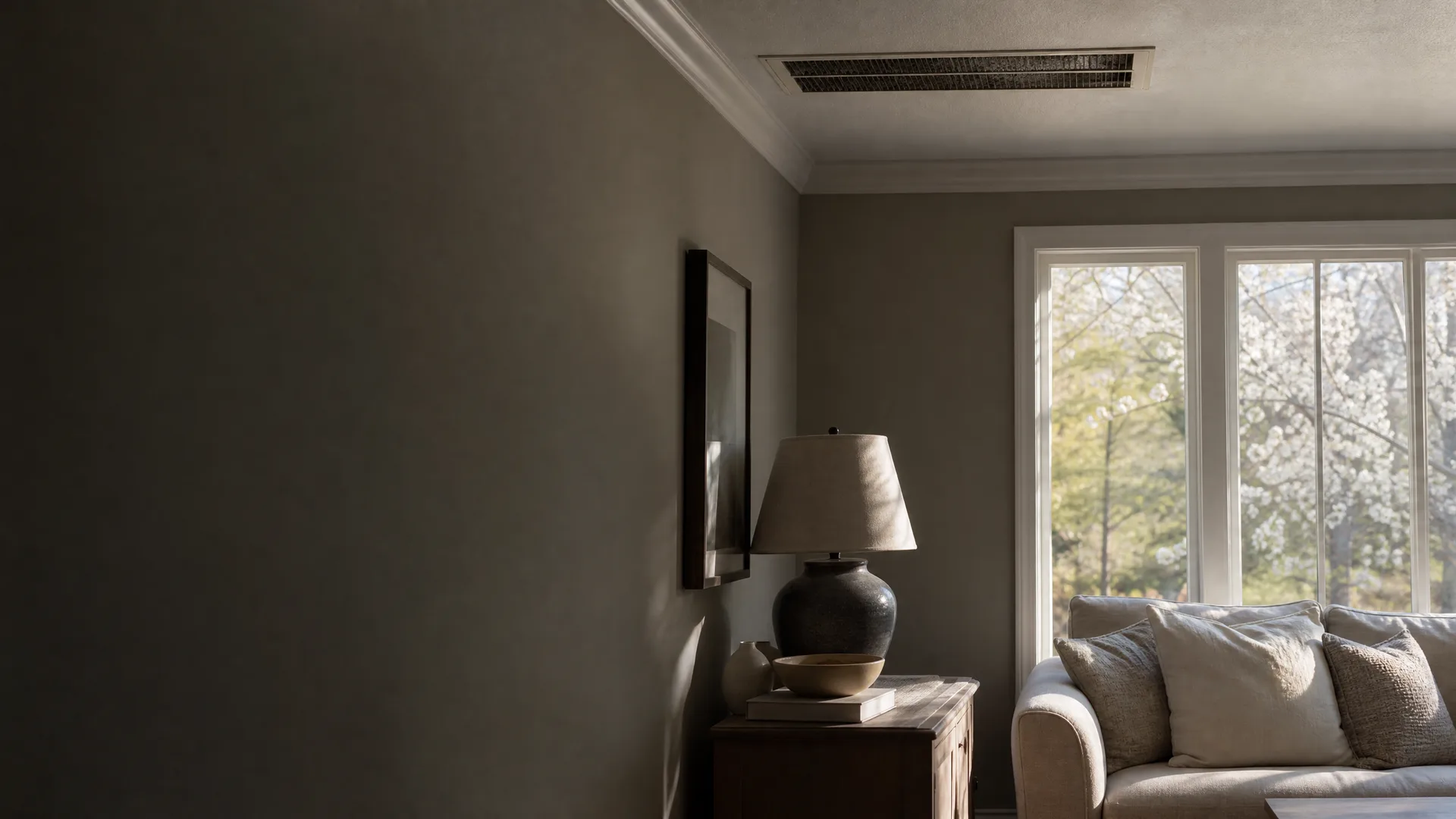
A dimly lit living room corner with a gray wall, framed picture, a table lamp on a wooden side table, a beige sofa with pillows, a ceiling vent, and windows showing flowering trees outside.

Late morning in April, sun coming in flat across the living room through the west window. The furnace cycled off twenty minutes ago but the air still smells faintly of the inside of the ducts. You run a finger along the ceiling vent grille and it comes back gray. Looking up, you can see dust has settled in a thin ring around the slats, thicker where the grille meets the ceiling. On the side table underneath, the same film sits across the wood, right where you wiped it down yesterday morning. The dog's asleep in the sun patch like nothing's wrong. You go get the cloth again.


The signs are the same ones you started with: dust back on the furniture a day after you clean it, a musty smell when the furnace kicks on, registers that need wiping more often than they used to. None of that means the ducts are dangerous, but it does mean they're the reason the dusting never seems to hold. A camera run through the trunk line will show what's actually sitting in there, and from that point the cleaning itself is straightforward work for someone who does it every winter in Ada County homes built the same way as yours. Finding that person is the only step left. A licensed local contractor who works on duct systems through the cold months here knows which joints tend to shed and which runs collect the most, and you'll be matched with one contractor, not a handful calling you back at once. From there it's a question of scheduling, not wondering whether the fix is right.

The gabled roof peak of a house with a stone chimney, dark siding and wood brackets, framed against forested hills and a rocky mountain ridge under a cloudy sky.

Send one request and you're done looking

Get a licensed local pro

There's no charge for the request.

A camera run through the trunk line settles it either way, instead of you guessing every time the furnace kicks on and that musty smell shows up again.